

If you measure everything, you understand nothing. Growth is not about doing more; it is about doing the one thing that creates the most value for your customer.
Key Takeaways
- Value Over Volume: A true North Star Metric (NSM) measures the value you deliver to customers, not just the money they give you.
- The Alignment Engine: A well-defined NSM eliminates departmental silos by giving product, marketing, and sales a single, unified target.
- Predictive Power: Your NSM acts as a leading indicator; when this number rises today, your revenue and retention rise tomorrow.

Overview: The Big Picture
Most startups and small businesses drown in a sea of “Vanity Metrics”—likes, downloads, and page views. While these numbers look good on a slide deck, they rarely tell you if your business is actually healthy or if you are on the brink of a “churn crisis.”
The North Star Metric is the single, most important rate of measurement that represents the core value your product delivers to its customers. It is the bridge between your product’s function and your business’s revenue. When you optimize for customer value, sustainable revenue becomes the natural, inevitable byproduct.
The Analogy: The North Star vs. The Horizon
Think of your business as a ship at sea. Revenue is the horizon—it’s where you want to go, but you can’t “steer” toward it directly because it shifts as you move. The North Star is your fixed point in the sky. Even in a storm, if the crew stays focused on that one star, the ship stays on course. If you steer toward the star (Customer Value), you will eventually reach the horizon (Profit).
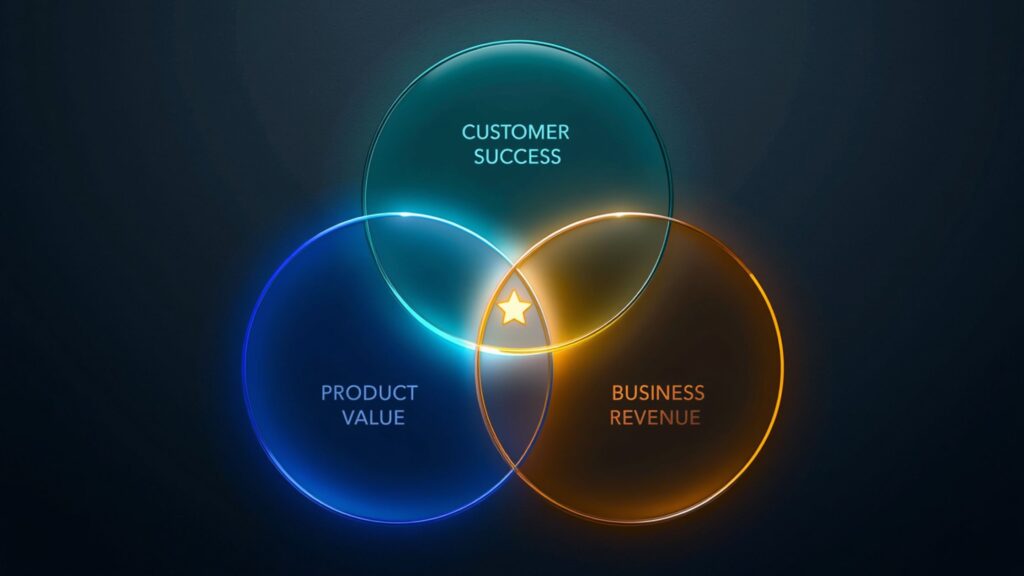
The Core Framework: The Three Pillars of a Great NSM
To ensure your North Star is effective and not just another number on a dashboard, it must meet three specific criteria:
1. It Measures Customer Success
It must track the exact moment a customer gets what they paid for. For a company like Airbnb, this isn’t “App Downloads”; it’s “Nights Booked.” One is a vanity metric; the other is a value exchange.
2. It Represents Product Value
If the number goes up, it should mean the product is getting better, more useful, or more essential to the user’s life. Growth without value is just a leak waiting to happen.
3. It Leads to Revenue
While the NSM itself isn’t a dollar amount, there should be a direct, logical link between this number rising and your bank account growing over time. It simplifies your financial forecast into a behavioral target.
Evidence in Action: Data & Real-World Examples
The most successful companies in the world don’t manage by spreadsheets; they manage by their North Star.
- The Statistic: According to a study by Mixpanel, companies that define and track a North Star Metric see a 60% higher rate of product-market fit retention compared to those tracking generic revenue KPIs. Furthermore, Bain & Company found that increasing customer retention by just 5% through value-based tracking can increase profits by 25% to 95%.
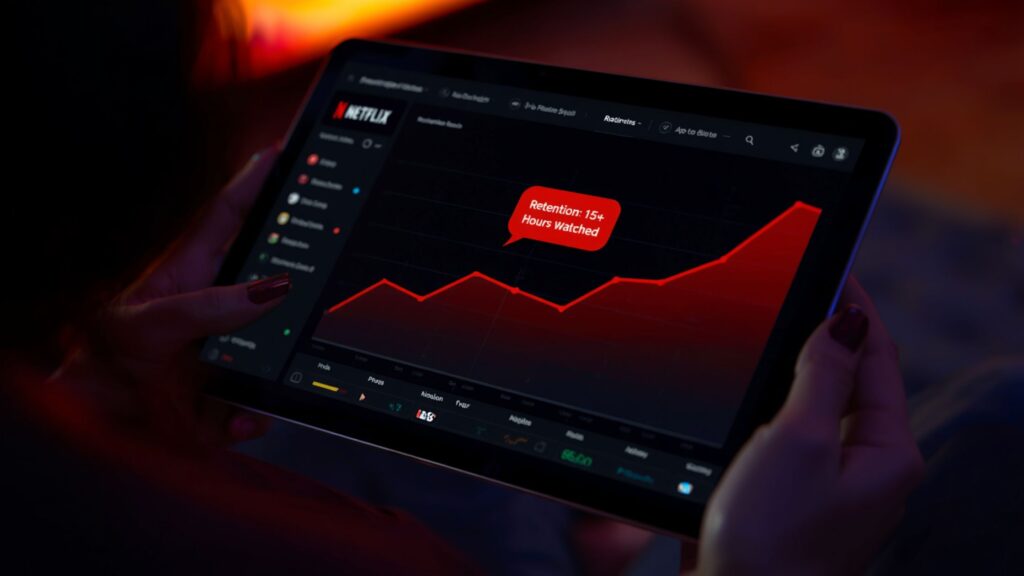
- The Case Study (Netflix): Netflix’s North Star isn’t “Subscription Revenue.” It is “Monthly Retention” (specifically measured by the number of hours a subscriber watches content). They know that if you watch 15+ hours of content a month, the probability of you canceling is nearly zero. Every feature they build—from the “Next Episode” button to personalized recommendations—is designed solely to move that one number.

The Deeper Truth: Revenue is a Result, Not a Strategy
The most common mistake founders make is setting “Monthly Recurring Revenue” (MRR) as their North Star. Revenue is a lagging indicator; it tells you what happened yesterday, not what will happen tomorrow.
- The Shift: Move your focus from “Closing the Sale” to “The Aha! Moment.” By measuring how quickly customers achieve their goals, you build a business that scales itself.
- The Common Pitfall: Tracking too many KPIs. If your team is confused about which number to prioritize, they will default to the easiest one (usually vanity metrics), not the most impactful one.
- The Competitive Advantage: Your job as a leader is to identify the “input metrics” (like support speed or feature adoption) that move the North Star. If you move the inputs, the North Star rises; if the North Star rises, the revenue follows.
How to Get Started: The 3-Step Workshop
Finding your North Star doesn’t require a data science degree. It requires a deep, honest understanding of your customer’s journey from “Problem” to “Solution.”
- Identify the “Aha! Moment”: Interview your best customers. Ask them: “When did you first realize this was worth the money?” That specific action is the foundation of your metric.
- Define Your “Game”: Are you in the Attention Game (Ad-based), the Transaction Game (E-commerce), or the Productivity Game (SaaS)? Your metric must match your business model’s core purpose.
- Audit Your Dashboards: Look at every chart you currently track. If a metric doesn’t directly influence your North Star, move it to a secondary folder. Clarity is your greatest competitive advantage.

Final Thoughts
Finding your North Star Metric is an exercise in discipline. It requires you to say “no” to a hundred good ideas so you can say “yes” to the one great one. Once you find it, your role shifts from a manager of tasks to an architect of growth.
The goal isn’t to be busy; it’s to be effective.