
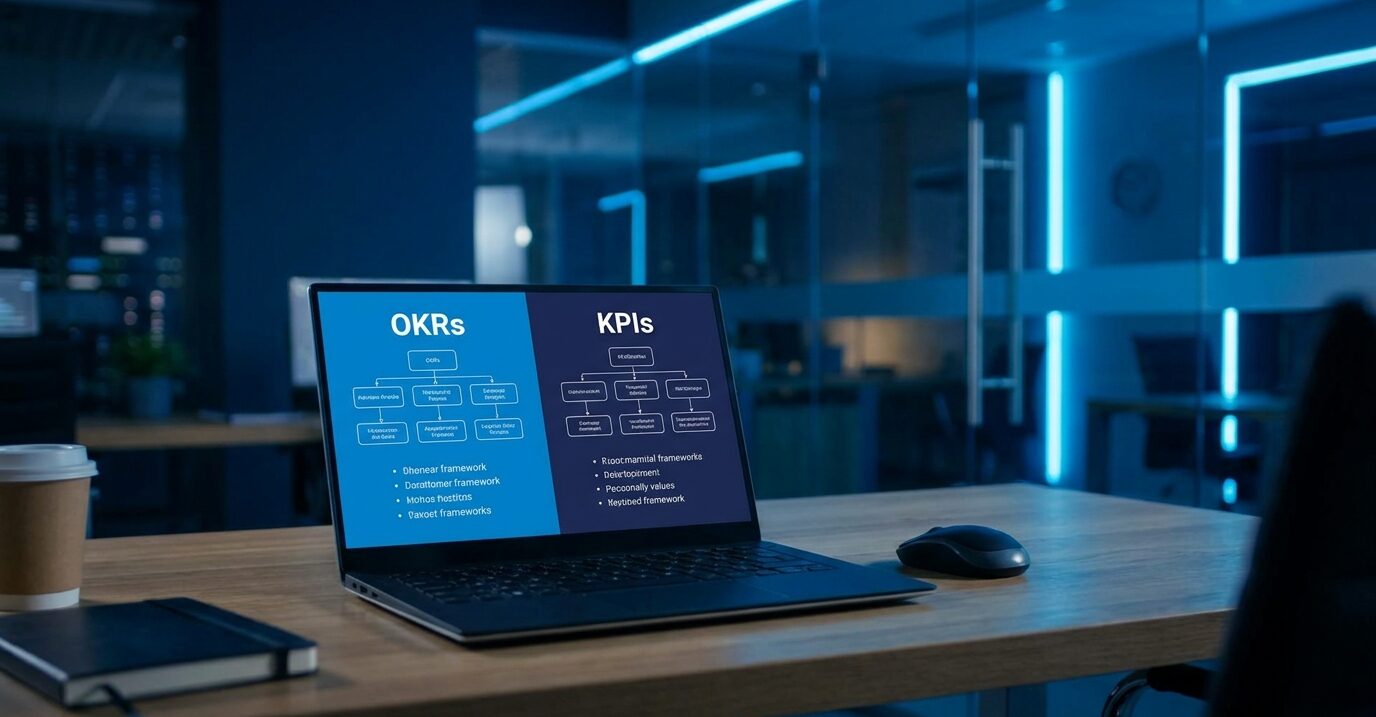
OKRs vs. KPIs: How to Set Ambitious Goals Without Losing Track of Daily Performance
A practical guide for business leaders who want to drive aggressive growth while keeping daily operations stable.
Understanding okrs vs kpis helps business leaders set ambitious targets without losing control of daily performance. Many growing companies struggle to balance long-term innovation with day-to-day operations.
When teams focus only on routine tasks, business growth stalls. Conversely, chasing aggressive milestones without monitoring routine health leads to operational chaos.
Comparing okrs vs kpis side by side reveals how both frameworks work together. This guide delivers a simple framework to align strategic vision with daily execution.
In This Article
- Understanding the Basics of Goal Setting
- OKRs vs KPIs: What Is the Real Difference?
- How OKRs Drive Strategic Innovation
- How KPIs Protect Your Daily Operations
- Combining Both Frameworks for Maximum Impact
- Practical Action Plan for Business Leaders
- Final Takeaway: Aligning OKRs vs KPIs
Understanding the Basics of Goal Setting
Every successful organization needs clear direction. Setting goals gives your workforce focus, purpose, and measurable targets.
Without structured frameworks, business teams waste time on conflicting priorities. Evaluating okrs vs kpis provides the structural clarity required to manage growth.
Research published by the Harvard Business Review indicates that agile goal alignment significantly accelerates organizational execution. Establishing clear targets ensures every team member contributes directly to bottom-line results.
OKRs vs KPIs: What Is the Real Difference?
The debate surrounding okrs vs kpis comes down to growth versus health. Both models serve distinct but complementary roles within your organization.
Objectives and Key Results (OKRs) define where you want to go. Key Performance Indicators (KPIs) measure how well your existing processes run today.
Here is a quick breakdown comparing okrs vs kpis:
- OKRs (Growth Focus): Ambitious, time-bound targets designed to push boundaries. Example: Launch a new market offer in 90 days.
- KPIs (Health Focus): Ongoing health metrics that monitor current output. Example: Maintain a 98% website uptime rate.
- Time Horizon: OKRs reset quarterly; KPIs monitor performance continuously.
- Success Target: OKRs aim for 70% achievement on aggressive stretch goals; KPIs demand 100% compliance.
Understanding okrs vs kpis prevents leaders from mistaking routine maintenance for strategic progress.
How OKRs Drive Strategic Innovation
Deploying OKRs encourages teams to think bigger. Instead of incremental improvements, OKRs push your company toward transformative milestones.
An Objective describes an inspirational destination. Key Results are three to five quantitative metrics that prove you reached that destination.
Using OKRs helps align marketing, sales, and product development. For instance, connecting team targets to a central North Star Metric ensures everyone pulls in the exact same direction.
Analyzing okrs vs kpis shows that OKRs provide the fuel for major market pivots.
How KPIs Protect Your Daily Operations
While OKRs fuel future expansion, KPIs safeguard your active cash flow. KPIs act like dashboard instruments in an airplane, indicating speed, fuel levels, and altitude.
Monitoring KPIs ensures core business functions remain healthy while you test new growth initiatives. Common business KPIs include customer acquisition cost, client retention rates, and website conversion percentages.

Building a reliable lead capture pipeline requires stable operational performance. A well-designed Marketing website relies on steady KPI monitoring to maintain top conversion rates.
Evaluating okrs vs kpis regularly highlights operational leaks before they damage revenue.
Combining Both Frameworks for Maximum Impact
The true power of okrs vs kpis emerges when you combine them into a single management framework. KPIs identify operational bottlenecks that need attention, and OKRs provide the strategic projects to fix them.
For example, if your client onboarding KPI drops below target, you create a quarterly OKR to rebuild the onboarding sequence. This relationship creates a self-reinforcing business Flywheel Effect.

Connecting overall strategy to market positioning is essential. Using STP Marketing ensures your ambitious targets target the most profitable client segments.
Maintaining this balance prevents burnout and keeps growth predictable.
Practical Action Plan for Business Leaders
Aligning okrs vs kpis across your company requires a systematic roll-out. Follow this four-week framework to implement both systems:
- Week 1: Audit your current business metrics and classify them into daily health KPIs versus strategic OKRs.
- Week 2: Define 3-5 organization-wide KPIs that monitor daily operational health.
- Week 3: Establish 1-2 quarterly OKRs for each department to drive strategic growth.
- Week 4: Set up weekly 15-minute KPI check-ins and monthly OKR progress reviews.
Ongoing infrastructure support is critical. Partnering with professionals for proactive Website Management keeps your digital sales engine running smoothly while you pursue ambitious milestones.
Final Takeaway: Aligning OKRs vs KPIs
Mastering okrs vs kpis provides the ultimate competitive advantage for growing businesses. KPIs protect current revenue, while OKRs unlock future market opportunities.
When you balance okrs vs kpis effectively, your business scales with confidence. Connect your strategic goals directly to a unified Marketing Operating System to automate lead capture and nurture pipelines.
Ready to align your strategic goals with a predictable digital marketing engine?
Schedule a 30-minute Discovery Discussion with our strategy team today. Explore more business insights on the Marketeering Blog or visit the Metro Annex Interactive Home.
Your Digital Marketing Department
Results vary based on industry execution, market conditions, and business model variables.
References
- Sull, D., & Sull, C. (2018). With Goals, Fast Beats SMART. Harvard Business Review. HBR Article
- Doerr, J. (2018). Measure What Matters: How Google, Bono, and the Gates Foundation Rock the World with OKRs. Portfolio / Penguin. Official Site
- Google Search Central. SEO Fundamentals and Guidelines. Google Search Portal