

“A product isn’t valuable because you built it well — it’s valuable because it relieves a pain or creates a gain your customer was already willing to pay for.”
Key Takeaways
- The Fit Principle: The Value Proposition Canvas splits value creation into two honest halves — what customers actually need (the Customer Profile) and what you actually offer (the Value Map) — and your entire business case lives in the overlap between them.
- The Fast Start: You can sketch a credible first draft of your canvas in under an hour with sticky notes and ten real customer conversations — no consultants, no six-week strategy sprint required.
- The Compounding Payoff: Teams that treat the canvas as a living document — revisited every quarter, not filed away after a single workshop — catch drifting product-market fit months before it shows up as a cash-flow problem.
Overview: The Big Picture
The Value Proposition Canvas, developed by Alexander Osterwalder and the Strategyzer team as an extension of the Business Model Canvas, exists to answer one deceptively hard question: why would someone actually choose to buy this? Most founders and product teams build from the inside out — they fall in love with a feature, a technology, or an idea, and only afterward go looking for someone to sell it to. The canvas forces the opposite discipline. It asks you to map your customer’s world first — their tasks, frustrations, and desired outcomes — and only then design your offer as a direct response to what you found.
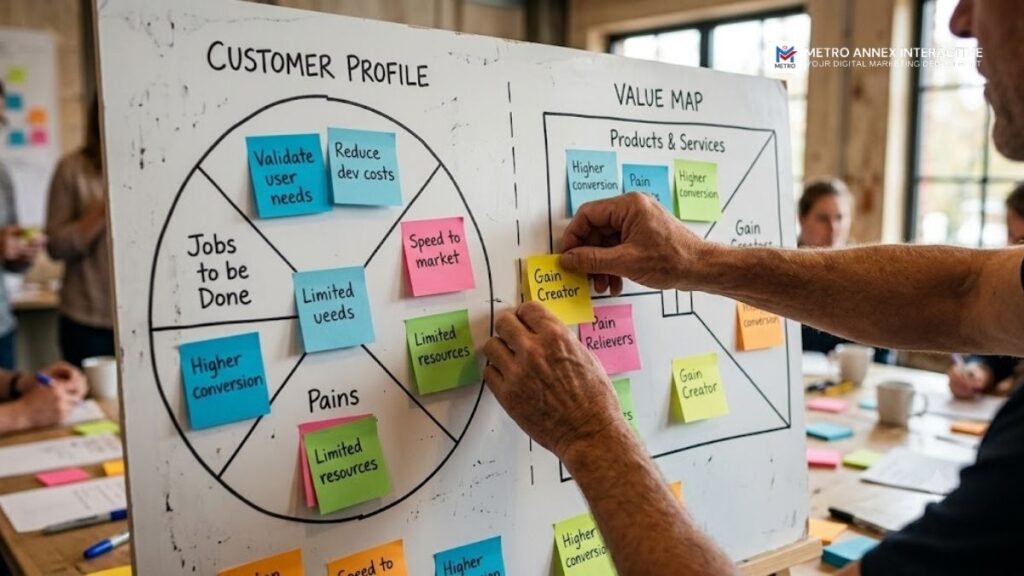
What makes the tool durable, more than a decade after its release, is its simplicity. It’s two visual halves — a Customer Profile and a Value Map — that you can literally draw on a whiteboard in a single working session. But simplicity is exactly why it gets misused: teams fill in the boxes quickly, congratulate themselves on “doing strategy,” and never go back to test whether the boxes are actually true. Used properly, the canvas isn’t a document you finish. It’s a hypothesis you keep trying to break.

The Analogy: Putting it into Perspective
Building a product without a Value Proposition Canvas is like a locksmith spending months hand-forging an intricate, beautiful key — without ever seeing the lock it’s meant to open. The craftsmanship might be exceptional. The metal might be flawless. But if the teeth don’t match the tumblers, the key is worthless, no matter how much time and money went into cutting it. The Value Proposition Canvas is simply the practice of studying the lock — the customer’s jobs, pains, and gains — before you start cutting the key.
The Core Framework: The Fit Model
1. The Customer Profile
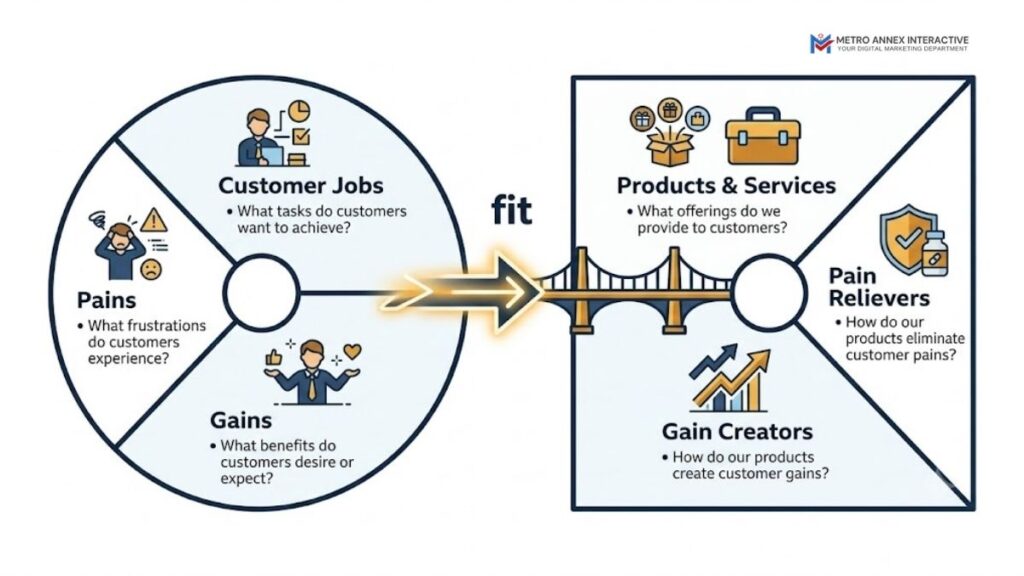
This is the circle half of the canvas, and it comes first — deliberately, because most teams get this backwards. It has three layers. Customer Jobs are the functional, social, and emotional tasks your customer is trying to get done, independent of any product (think “get to the airport on time,” not “book a rideshare app”). Pains are the obstacles, risks, and frustrations that stand between the customer and finishing that job. Gains are the outcomes and benefits the customer wants beyond simply solving the problem — the upside, not just the relief. The single biggest mistake in this section is writing down what you assume customers want instead of what you’ve actually heard them say in an unscripted conversation.
2. The Value Map
This is the square half, and it should only be built after the Customer Profile is filled in — not before. Products & Services are simply the list of what you sell. Pain Relievers describe exactly how your offer eliminates or reduces the specific pains you identified. Gain Creators describe how your offer produces the specific gains your customer is after. Notice the pattern: every item in the Value Map should trace back to a specific item in the Customer Profile. If it doesn’t, it’s a feature you built because it was interesting to build — not because anyone asked for it.
3. Achieving Fit
Fit is the point of the whole exercise, and it happens in three escalating stages. Problem-solution fit is a hypothesis — you believe your Value Map addresses real Jobs, Pains, and Gains, but it’s untested. Product-market fit is evidence — customers are actually buying, using, and returning for your offer. Business model fit is durability — the economics of delivering that value proposition actually work at scale. Most canvases die at stage one because teams treat the first draft as the finished answer instead of the starting hypothesis to go test in the market.
Evidence in Action: Data & Real-World Examples
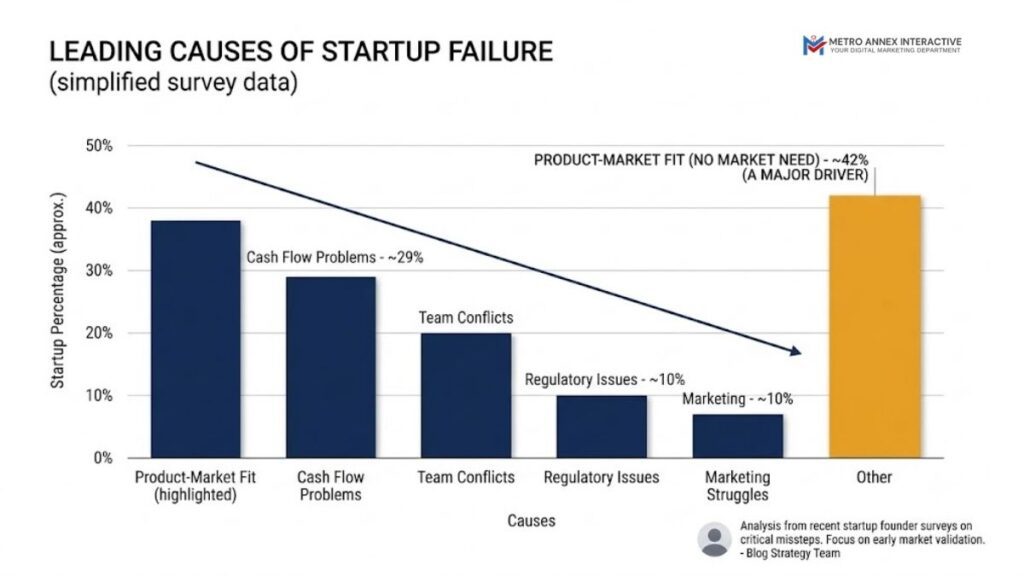
The Statistic: <cite index=”2-1″>A 2024 CB Insights analysis of 431 venture-backed companies that shut down found that poor product-market fit was the leading root cause of failure at 43%, ahead of bad timing (29%) and unsustainable unit economics (19%)</cite>. Running out of cash is almost always the headline reason founders give — but <cite index=”2-1″>it’s largely the final symptom of a deeper problem, not the root cause itself</cite>. In plain terms: the money didn’t disappear randomly. It disappeared because not enough customers valued the product enough to pay for it. That is precisely the failure mode the Value Proposition Canvas is built to catch early, while it’s still cheap to fix.
The Case Study: Hilti, the Liechtenstein-based manufacturer of professional construction tools, is one of the most widely taught examples of value proposition redesign in action. For decades, Hilti sold drills, saws, and heavy equipment the way every competitor did — as one-time purchases. But when the company mapped the actual “job” its customers were trying to get done, the insight wasn’t “own a drill” — it was “keep a job site running without equipment downtime, theft, or maintenance headaches.” That single reframe led Hilti to launch its Fleet Management program: instead of selling tools, it now leases a fully maintained, always-available fleet of equipment for a predictable monthly fee — directly relieving the pains (downtime, repair costs, tool theft) that were buried underneath the original “sell a drill” business model. The tools barely changed. The business built around them was transformed.
The Deeper Truth: Strategic Synthesis

The Shift: The canvas requires a fundamental change in mindset — from “what can we build?” to “what does the customer need done, and what’s currently stopping them?” That sounds obvious in a blog post. It’s remarkably hard to practice in a real organization, where engineering roadmaps, founder intuition, and sunk cost all quietly pull decision-making back toward the product instead of the customer.
The Common Pitfall: Teams fill in the Value Map first — because it’s easier to talk about what you’re building than to go interview strangers — and then reverse-engineer a Customer Profile that conveniently justifies it. This produces a canvas that looks complete and feels productive, but was never actually tested against reality. It’s confirmation bias wearing a strategy-framework costume.
The Competitive Advantage: Companies that genuinely start from the Customer Profile ship fewer unused features, write sharper marketing copy because they’re echoing the customer’s own language back to them, and price with more confidence because they know exactly which pain or gain they’re charging for. The payoff isn’t a prettier canvas — it’s fewer expensive bets built on assumptions nobody checked.
How to Get Started: The Tactical Guide
Final Thoughts
The Value Proposition Canvas doesn’t succeed because it’s clever — it succeeds because it’s honest. It refuses to let you skip the uncomfortable step of finding out whether anyone actually wants what you’re building, before you spend the months and the capital to build it. The businesses that last aren’t the ones with the best products in isolation — they’re the ones that never stopped checking their product against a customer’s real, unfiltered problem.